Ces produis sont amenés à être utilisés dans des conceptions et des realisations qui font appel aux normes suivantes :
( ne se substitue pas à la documentation officielle)
RTCA DO-254/Eurocae ED-80 "DESIGN ASSURANCE GUIDANCE FOR AIRBORNE ELECTRONIC HARDWARE"
La DO-254 présente 5 niveaux de criticité (de A à E) définis comme suit :
* Niveau A : Problème catastrophique - Sécurité du vol ou atterrissage compromis - Crash de l'avion
* Niveau B : Problème majeur entraînant des dégâts sérieux voire la mort de quelques occupants
* Niveau C : Problème sérieux entraînant un dysfonctionnement des équipements vitaux de l'appareil
* Niveau D : Problème pouvant perturber la sécurité du vol
* Niveau E : Problème sans effet sur la sécurité du vol
ED-12B et DO-178B Software considerations in airborne systems and equipment certification développées en commun et éditées respectivement par EUROCAE (en) et RTCA Inc., fixent les conditions de sécurité applicables aux logiciels critiques de l'avionique dans l'aviation commerciale et l'aviation générale
Elles présentent 5 niveaux de criticité (de A à E) définis comme suit :
* Niveau A : Problème catastrophique - Sécurité du vol ou atterrissage compromis - Crash de l'avion
* Niveau B : Problème majeur entraînant des dégâts sérieux voire la mort de quelques occupants
* Niveau C : Problème sérieux entraînant un dysfonctionnement des équipements vitaux de l'appareil
* Niveau D : Problème pouvant perturber la sécurité du vol
* Niveau E : Problème sans effet sur la sécurité du vol
Ces 5 niveaux sont aussi appelés niveaux DAL (Design Assurance Level).
Les Niveaux sont établis par les études de sûreté de fonctionnement. Ces études fixent alors le niveau DAL pour le matériel et le logiciel conformément aux normes de sécurité (EUROCAE (en) ED-79 et SAE ARP4754 "Certification considerations for Highly-Integrated and Complex Aicraft Systems") ou directives de l'avionneur (ABD100, ABD200,...). Le niveau DAL d'un sous-système peut être différent du niveau système à la condition que le niveau DAL du système soit atteint par une architecture matérielle/logicielle adéquate.
RTCA DO-160F « Environmental Conditions and test Procedures for Airborne Equipment »
RTCA DO-160F - Site RTCA
EUROCAE ED-14F - Site EUROCAE
Vingt-six sections constituent la DO-160F / ED-14F, les deux premières sont générales et précisent le but, les définitions et des généralités. La troisième précise les conditions générales de test. Les suivantes définissent chacune, pour un type de test, les environnements, la catégorisation qui permet de déterminer l'environnement applicable, et les procédures de test
MIL-PRF-23648
Military Grade NTC Precision thermistors, MIL-PRF-23648
M23648/19 Military Precision PTC Thermistor
MIL-D- 8181 B . DETECTOR, ICE, AIR INTAKE DUCT, AIRCRAFT ENGINES AND AIRFRAME ...
MIL-HDBK-217F : norme militaire américaine, conçue pour estimer la fiabilité des équipements. (calcul de la MTBF)
MIL-STD-810 "Department of Defense Test Method Standard for Environmental Engineering Considerations and Laboratory Tests" emphasizes tailoring an equipment's environmental design and test limits to the conditions that it will experience throughout its service life, and establishing chamber test methods that replicate the effects of environments on the equipment rather than imitating the environments themselves. MIL-STD 810 is a generally accepted standard of ruggedisation testing (
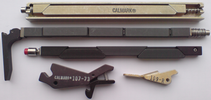
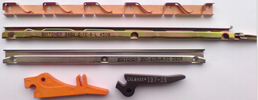
BCFMKM Importation, Distribution, Sourcing de glissiere calmark et birtcher, nombreuses piece en stock ! ideal pour les chassis MIL-STD-810)
TSO.C1D , Technical Standard Orders (TSO) - aviation regulatory
TSO.C1D C1d Cargo Compartment Fire Detection Instruments
TSO.C2D C2d Airspeed Instruments
TSO.C3D C3d Turn and Slip Instrument
TSO.C4C C4c Bank and Pitch Instruments (Indicating Gyro-Stabilized Type) (Gyroscopic Horizon, Attitude Gyro)
TSO.C5E C5e Direction Instrument, Non-Magnetic (Gyroscopically Stabilized)
TSO.C6D C6d Direction Instrument, Magnetic (Gyroscopically Stabilized)
TSO.C7D C7d Direction Instrument Magnetic Non-Stabilized Type (Magnetic Compass)
TSO.C8D C8d Vertical Velocity Instruments (Rate-of-Climb)
TSO.C9C C9c Automatic Pilots
EASA PART 145 (atelier de maintenance) L'aéronautique civile européenne impose aux organismes d'entretiens d'aéronefs ou équipements d'aéronefs d'appliquer des règlementations d'entretien en particulier, le PART 145 (règlement CE 2042/2003) en vue d'obtenir un agrément par la DGAC (en France) et de pouvoir délivrer un certificat de navigabilité (EASA Form1) avec les équipements réparés ou révisés.
C1 Air Cond & Press C2 Auto Flight
C3 Comms and Nav C4 Doors – Hatches
C5 Electrical Power C6 Equipment
C7 Engine – APU C8 Flight Controls
C9 Fuel – Airframe C10 Helicopter –Rotors
C11 Helicopter –Trans C12 Hydraulic
C13 Instruments C14 Landing Gear
C15 Oxygen C16 Propellors
C17 Pneumatic C18 Protection ice/rain/fire
C19 Windows C20 Structures
EASA Part-21
Part 21J Design Organization Approval
PART 21G : Production Approval
MIL-PRF-22885 : Switches, Push Button, Illuminated,
General Specification for Federal Supply Classes 5930
This specification covers the general requirements for manually operated illuminated push button switches, switch assemblies, and associated modular subassemblies. As used in this specification, the term "switches" shall include the associated modular subassemblies, including switches, indicator lights, actuators, lenses, color filters, panel seals, barriers, and so forth.
MIL-L-85762A , MILITARY SPECIFICATION LIGHTING, AIRCRAFT, INTERIOR, NIGHT VISION IMAGING SYSTEM (NVIS) COMPATIBLE
MIL-STD 3009 , superceding MIL-L-85762A LIGHTING, AIRCRAFT, NIGHT VISION IMAGING SYSTEM (NVIS) COMPATIBLE
SAE ARP 4392 : Lighting, Aircraft Exterior, Night Vision Imaging System (NVIS) Compatible
NATO STANAG 3800 Night Vision Imaging System (NVIS) Interior Lighting Compatibility Design Criteria
MIL-STD-461 F: Requirements for the Control of Electromagnetic Interference Characteristics of Subsystems and Equipment.
MIL-STD 461 is basically divided into two areas, Emissions and Susceptibility. The electromagnetic effects are either conducted or radiated.. MIL-STD 461 establishes the requirements for Conducted Emissions, Conducted Susceptibility, and Radiated Emissions Radiated Susceptibility.
1/ Conducted Emissions 2/Conducted Susceptibility
3/ Radiated Emissions 4/ Radiated Susceptibility
TEMPEST : acronyme officiel de Telecommunications Electronic Material Protected from Emanating Spurious Transmissions.
NF EN 50121 . - Applications ferroviaires. - Compatibilité électromagnétique
SAE AS7788 or old MIL-P-7788 : Panels, Information, Integrally Illuminated
This specification covers the general requirements for integrally illuminated information panels.Lightplates can be broken down into 5 main types as defined in SAE AS7788.
Type III One piece plastic panels. These panels typically use front replaceable post lamps for illumination. This type of panel is inactive for new designs.
Type IV One piece integrally wired panels. These panels have the lighting circuit and lamps embedded within the panel. They are commonly referred to as embedded panels. This type of panel is normally not used for new designs.
Type V Printed circuit board panels. These panels have the lighting circuit and incandescent lamps on a separate circuit board. This is the most common panel currently in production.
Type VI Electroluminescent Panels. These panels feature and encapsulated electroluminescent lamp. Due to limited electroluminescent life, these panels have limited applications for new designs.
Type VII Light Emitting Diode (LED) panels. These panels have the lighting circuit and LED's on a separate circuit board. This type of panel is the most common panel for new fight deck applications.
MIL-PRF-38039C General Specification For Systems, Illuminated, Warning, Caution, And Advisory
EN 50155:2001 . Applications ferroviaires — Équipements électroniques utilisés sur le matériel roulant.
MIL-C-14806A , MILITARY SPECIFICATION, COATING, REFLECTION REDUCING, FOR INSTRUMENT COVER GLASSES AND LIGHTING WEDGES (12 JUN 1969)., This specification covers reflection reducing coatings applied to substrate material having indices of refraction within the range of 1.47 to 1.55 to be used as instrument cover glasses and lighting wedges herein referred to as optical elements.
BSI BS 6206 Impact Performance Requirements for Flat Safety Glass and Safety Plastics for Use in Buildings remplacé par la EN 12600:2002 Glass in building. Pendulum test. Impact test method and classification for flat glass. Pendulum test. Impact test method and classification for flat glass
EN 60601-1-1:2001 (Systèmes électromédicaux)
EN 60601-1-4:1996 (Systèmes Electriques Médicaux Programmables)
ISO 80601 : Équipement électrique médical
Directive 89/336/CEE : rapprochement des législations des États membres relatives à la comptabilité électromagnétique remplacé par la Directive 2004/108/CE
Directive 2004/108/CE : rapprochement des législations des États membres concernant la compatibilité électromagnétique et abrogeant la directive 89/336/CEE
IEEE 299-2006 . IEEE Standard Method for Measuring the Effectiveness of Electromagnetic Shielding Enclosures
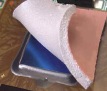
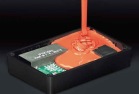
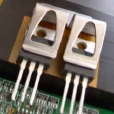
Matériaux thermoconducteurs, Standard Silicone Thermal Pads ,Thermally Conductive Silicone Interface Pads ,Silicone-based thermal pad with high conductivity, CPU thermal silicon pad -High thermal conductivity,thermal conductive pad made of Silicon rubber ....